The Esquiline Treasure
British Museum

The Esquiline Treasure is a large find of over sixty pieces and seventy pounds of silver plate, found in 1793 on the Esquiline Hill in Rome. It consists of the Projecta Casket, the Muse Casket, and four furniture fitting of city tychai.
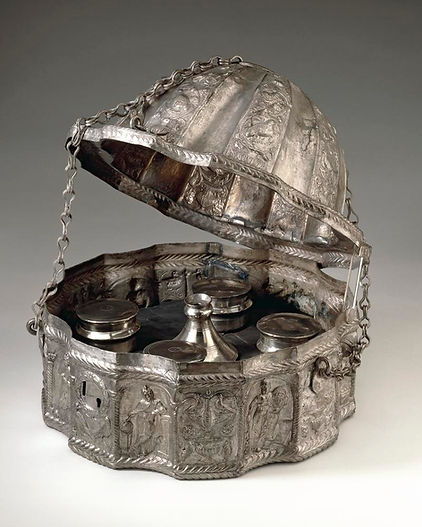
The Muse Casket
Rome, mid-4th century
Silver, 25.4 x 33.2 cm
The casket, which can be suspended from three chains attached to a large ring, contains five small vessels for perfumes and unguents fitted into openings in a horizontal bronze plate. The domed cover of the casket is joined to the body with a hinge and is closed and secured by means of a tapering hasp and staple. Representations in mosaics and wall paintings have shown objects that closely resemble the muse casket in the context of the Roman bath.
The surfaces of both body and dome have been divided into sixteen panels, alternating flat and concave surfaces. The flat surfaces are decorated with vases, vine motifs, and birds; the eight fluted panels of the dome are undecorated ; and those of the body contain female figures under arches. At the top of the dome is a medallion that contains another female figure seated in a landscape setting. The eight figures of the body can be identified as eight of the nine muses. While it is tempting to identify the ninth figure as the ninth muse, this seated figure — associated with a bird, a basket of fruits, and a tree decked with garlands — seems drawn from another sphere. She does not display an attribute as do the rest ; and she does not wear the feather headdress, which unites the band of eight and alludes to the victory of the muses over the Sirens. Whoever she may be, the ninth figure is meant to be associated with the muses, as the portrait figure of a deceased woman may take the place of a ninth muse on sarcophagi reliefs.
To the right of the hasp, reading counterclock-wise, the muses are: Urania, muse of astronomy, with a globe; Melpomene, muse of tragedy, with a Heraclean club and a tragic mask; Clio, muse of history, with a book and a capsa with scrolls; Polyhymnia, muse of mime, with a small, ''silent" mask; Terpsichore, muse of lyric poetry and dance, with a lyre and a dancing posture; Euterpe, muse of flutes, with her instrument, the double flute; Thalia, muse of comedy, with a Dionysiac pedum and comic mask ; and Calliope, muse of epic poetry, with a scroll.
Although distinguished from one another by costume and attribute, the muses are represented as variations of a single, rather stocky type. The treatment of their draperies, facial features, and postures is very similar to the execution of figures on the Projecta Casket, with which the Muse Casket was found in 1793, as part of the Esquiline Treasure. The identification and sequence of the muses on the casket can be compared with the late fourth-century ewer with nine muses from the Kremlin Armory. That the muses would be considered appropriate decorative motifs on objects — however precious — intended for domestic use only testifies to the popularity of the theme in the classical and Late Antique world.

The Projecta Casket
Rome, mid-4th century
Silver with silver gilt, 30 x 55 x 43 cm
The body of the large casket is a truncated rectangular pyramid whose sides are isoceles trapezoids ; the lid is smaller and similar in shape, surrounded by a horizontal rim with a narrow vertical lip. Three hinges connect the lid and body. The casket once rested on four corner braces, of which three remain, and the object was carried by two swing handles attached to the short ends of the body. The casket has survived in excellent condition with only one major area of restoration on the right end panel of the lid.
The name by which the casket is known, the Projecta Casket, derives from the woman's name in the Latin inscription engraved on the rim across the front of the lid: secvnde et proiecta vivatis in christo ("Secundus and Projecta, live in Christ"). Portraits of the couple, encircled in a wreath, displayed by flanking Erotes, decorate the top of the casket lid.A representation of the Toilette of Venus rises directly above the inscription. The combination is not unusual; the subject is understood not so much as pagan mythology but as a flattering visual analogy to Projecta. Venus, who performs her toilette surrounded by sea creatures, Erotes, and Nereids extending to either side, is the model for the Roman matron on the casket body, who adjusts her coiffure in the company of torchbearers and handmaidens. Projecta and Venus are aligned with one another on a vertical axis; they perform the same functions, in similar postures, however distinct their environments.
The back panel of the casket lid is occupied by a toilette procession. In an active scene from daily life, Projecta, with her properly braided and coiled fourth-century hairstyle, proceeds to an elaborately domed Roman bath in the company of attendants. Some of the boxes and containers carried by the attendants depicted on the casket body resemble the Projecta Casket itself, and one on the back panel of the body resembles the Muse Casket.
The relationship between the two caskets extends beyond a common find-site and general function : the standing female figures of the Projecta Casket closely resemble their counterparts on the muse casket in facial and postural type and in the handling and decoration of draperies. The statuettes of four city goddesses from the Esquiline treasure also follow this style.
All six pieces are best understood as products of the same workshop. A damaged silver vessel from the treasure of Traprain Law, dated on numismatic evidence to the late fourth to early fifth century, provides a stylistic parallel to the Esquiline pieces. The analogies of the figural decoration of the Corbridge lanx and the Parabiago plate also support a fourth-century date for the pieces. The Esquiline Treasure, a large find of over sixty pieces and seventy pounds of silver plate, was found in 1793 on the Esquiline Hill in Rome.

Furniture fittings depicting city Tychai
Rome, c.330-370
Silver and gold
Shown here as female personifications or goddesses, known as Tychai, are the four most important cities of the Roman world in the 4th century. These cities also became, by the end of the 4th century, the most important seats of Christian bishops, with Constantinople supplanting Jerusalem by virtue of the former’s imperial status as the New Rome. Alexandria (on the far right) wears a crown depicting the city walls complete with turrets and gates; she carries fruit and sheaves of wheat symbolizing the bounty shipped up the Nile and exported through the city’s great harbour (represented by the ship’s prow upon which she rests her foot).


