
Hiereia
Fenerbahçe/Kadıköy

View of Fenerbahçe Lighthouse and the site of the Palace of Hiereia
Hiereia (modern Fenerbahçe) was the name of the cape southeast of Chalcedon (modern Kadıköy). It was the site of a sixth-century Palace of Hiereia and a church dedicated to the Virgin Mary, both of which were constructed during the reign of Justinian I. It was a favorite palace of Empress Theodora (wife of Justinian) and Heraclius. Byzantine sources indicate it was a popular imperial residence from the sixth to the mid-eleventh century. The Harbor of Eutropios (modern Kalamış), also built by Justinian, was located around 1 km north of the Fenerbahçe peninsula.

Ruins of cistern rediscovered in 2016
History
Hiereia (Ἱέρεια) was the Byzantine name of the cape terminating in a small peninsula located southeast of Chalcedon (modern Kadıköy) near the mouth of the Bosphorus. The broad peninsula was connected to the mainland by a narrow isthmus, though it is now cut by a channel. Built by Justinian, the Palace of Hiereia was an imperial residence until the mid-eleventh century. Although the palace had its own harbor, Justinian also built a second harbor a short distance north known as the Harbor of Eutropios (modern Kalamış).
Confusingly, Byzantine sources give two basic variants of the name, both of which can be found in the writing of Prokopios as well as later sources. Heraion (Ἡραῖον) implies a sanctuary of the goddess Hera, while Herion (Ἤριον) means tomb or burial mound (tumulus). The former suggests the peninsula was somehow sacred to the goddess Hera, perhaps because it was once home to a sanctuary of Hera. Alternatively, it has been argued that it was a cemetery, perhaps a necropolis of Chalcedon. The spelling Hiereia (Ἱέρεια), implying a sacred festival, was common by the ninth century. The latter spelling may refer to an annual vintage festival celebrating the grape harvest. Its modern name Fenerbahçe (“lighthouse garden”) derives from an Ottoman lighthouse, which was also known as Fanaraki (Φαναράκι).
During the reign of Justinian I (527-565), a palace complex and church dedicated to the Virgin Mary were constructed on the peninsula of Hiereia. It seems that it became a favorite of Empress Theodora. Archaeological evidence also indicates a water channel carried water from the north, which was stored in a large cistern on the mainland. The complex probably had colonnades, squares, public baths, and other type of buildings, along with its own harbor. Justinian’s successors, including Justin II (565-578) and his wife Sophia, further embellished the palace. Hiereia is regularly mentioned in Byzantine sources as a residence and the site of imperial crossing to Constantinople in the next five centuries. According to the ten-century Book of Ceremonies, there was an annual vintage festival, which began in the vineyards of Chalcedon, included the blessing of the grape harvest by the emperor and the patriarch, and concluded with a banquet in the Palace of Hiereia. This festival is possibly first mentioned during the reign of Tiberios II (578-582). Viniculture continued into the Ottoman era.
The Palace of Hiereia was particularly prominent during the reign of Heraclius (610-641). It appears frequently in the sources about his reign, suggesting it was his favorite residence. In 611, his daughter Epiphania (named after his mother) was born to Eudokia at the palace. In the winter of 621/22, Heraclius withdrew to the palace. At some point, he filled the old cisterns with gardens and parks. Following his victory over the Sasanian Persians, Heraclius returned to Constantinople in 629. He was first greeted at Hiereia by inhabitants of the city, accompanied by the patriarch, before continuing the imperial triumph in the capital. Following the Arab victory at the Battle of the Yarmuk in 636, Heraclius returned to the vicinity of Constantinople and resided at the Palace of Hiereia for a period. A conspiracy to overthrow Heraclius, which included family members, took place during this period. Reportedly, he developed a phobia of water, making him afraid to travel by sea. He stayed at Hiereia for a considerable amount of time; h only left, so the account goes, when a special pontoon bridge of boats was constructed, allowing him to cross the Bosphorus. The sources seem to indicate that he left his mark on the palace.
The palace hosted the iconoclastic Council of Hiereia of 754, which was held during the reign of Constantine V. This council, later rejected by the Second Ecumenical Council of Nicaea in 787, condemned the veneration and production of images. In 765, Constantine V briefly exiled Patriarch Constantine II to Hiereia, before sending him to Prinkipos (Büyükada). In 768, Irene of Athens stayed at Hiereia before her ceremonial entry to Constantinople for her marriage to Leo IV, son of Constantine V. In 799, the Empress Irene was residing at Hiereia when she accused Staurakios of attempting to overthrow her. Miracles are reported at Hiereia after Theophanes the Confessor was laid to rest there for a year in 818. After a successful campaign in Cilicia (in 831 or 837), Theophilos stayed at Hiereia, while waiting a week for Arab prisoners of war he wanted to display in his triumphal entry into Constantinople. When the deposed Patriarch Ignatios was exiled in 858, he was briefly imprisoned in a goat pen at Hieria.
Basil I (867-886) restored the large cistern of the palace, which had been turned into gardens by Heraclius. He also had a chapel dedicated to the Prophet Elijah built in the palace complex. When Basil I returned to Constantinople in 879 after a successful campaign, he stopped by Hiereia on his way to the Hebdomon where his triumphal procession began. At this time, Arab prisoners of war were also brought by ship from Hiereia to be displayed in the triumphal procession. The traitor Apostypes was brought to Basil I when he was staying at Hierion. Apostypes was then tried at Hierion and ordered to be mutilated and then exiled to Mesembria. According to De Administrando Imperio, an imperial galley was built during the reign of Leo VI (886-912) to visit more distant sites (such as Rhegion and Prousa), though emperors continued to use a scarlet imperial barge to travel to nearby sites like Hiereia and Bryas. In 877, the patriarch Nicholas I Mystikos was invited to the Great Palace, so Leo VI could try to persuade him to accept his fourth marriage to Zoe Karbonopsina. However, as the patriarch rejected this proposal, he was forced to abdicate and was sent by boat from the Boukoleon harbor to Hieria. From there, he had difficulty marching through deep snow to reach the nearby Galakrenai Monastery. Constantine VII Porphyrogenitus (913- 959) also added buildings to the Palace of Hiereia. After being proclaimed emperor in Cappadocia in 963, Nikephoros II Phokas first went to Hiereia before entering Constantinople.
The palace is last mentioned in the reign of Romanos IV Diogenes. In 1069, he spent Easter at Hiereia while preparing for his campaign against the Seljuks. He also stayed at Hiereia before his military campaign, when he lost the Battle of Manzikert in 1071. The Palace of Skutarion at Damalis (Üsküdar) became the main imperial palace on the Anatolian shores of the Bosphorus during the Komnenian era.
The area became known as Fenerbahçe after a lighthouse was built during the reign of Suleiman the Magnificent. An Ottoman pavilion was also built there around this period. It has been suggested that the remains of the Byzantine palace complex were used in the construction of this Ottoman pavilion.

View of Fenerbahçe Peninsula from Moda (historic Chalcedon)
Inscriptions from Justinian’s Palace of Heraia recorded in The Greek Anthology
On the Entrance of the Heraeum
Justinian built this magnificent house,
a thing of beauty to overhang land and water.
Τοῦτον Ἰουστινιανὸς ἀγακλέα δείματο χῶρον,
ὕδατι καὶ γαίῃ κάλλος ἐπικρεμάσας.
From the same [Princes]
Time will always proclaim your virtue, power, and great deeds,
as long as the stars move in heaven.
Κοίρανοι, ὑμετέρην ἀρετὴν κάρτος τε καὶ ἔργα
αὐδήσει χρόνος αἰέν, ἕως πόλος ἀστέρας ἕλκῃ.

Ruins of 6th-century cistern rediscovered in 2016
From Buildings by Procopius
Also in the Heraion, which is now called Hiereion, he [Justinian] built a church for the Mother of God which is not easily described.
He also created palaces elsewhere, newly designed by him, at the Heraion, which they now call Hieron, and in the place named Ioukoundianai. Neither their magnificence combined with technical precision, nor their magnitude, could I ever fittingly describe with becoming words. For it will suffice to say that they are imperial residences, and that Justinian brought both his presence and his forethought to their construction, and nothing was disregarded, except for the expense. In fact, it would even be impossible for its sum not to exceed calculation...And he set up another port on the opposite mainland, in the place called after Eutropios, not far from the aforementioned Heraion, constructed in the same way as the port I have just described.
From The Secret History by Procopius
She [Theodora] spent most of the year in the suburbs by the coast, mostly in the palace known as Herion. This imposed considerable hardship on her army of attendants, for necessities were in short supply and they incurred dangers from the sea too, especially if a winter storm happened to pick up or the whale made a surprise appearance. But they believed that the evils that afflict all of mankind were as nothing, at least so long as it was possible for them to live in luxury.
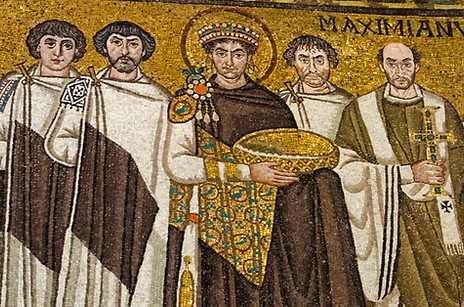

Mosaics of Justinian and Theodora in San Vitale
Archaeology
Nineteenth-century reports indicate there were remains of a cistern near a Catholic monastery (now the Church of St. Augustine) on the mainland. The remains of this cistern were rediscovered during construction excavations for a new apartment building in 2016. In addition, water channels were also discovered around 700 m to the northeast. This large cistern was probably associated with the sixth-century Palace of Hiereia. Since only the lower walls survive, there is no evidence for any vaulting, although its large size suggests it was an open cistern. No other remains of the palace complex have been discovered, though early reports indicate more survived during the Ottoman era.
As the Fenerbahçe peninsula projects out into the sea, it would have required large breakwaters or moles to project its harbor. While no remains of the breakwater or pier survive, it is likely they were on the western side of the peninsula near the lighthouse. Its old harbor walls and moles were probably in good condition during the sixteenth century. It is also likely that the remains of the pier were repaired and continued to be used in the Early Ottoman era as well. The remains of the harbor moles of Hiereia and Eutropios, which consisted of black stones, were still visible in the early twentieth century.

Photo of water channel by Dr. Kerim Altuğ (2019)

Location of cistern from map of Chalcedon and Hiereia
Janin (1964)

Tarihi duvar bakiyesi (Ruins of historic wall)

Kalamış Marina and Fenerbahçe Lighthouse
Harbor of Eutropios
The Harbor of Eutropios (Εὐτροπίου λιμήν) was located less than 1 km north of Hiereia. It is now the site of the Kalamış Marina. The origin of its name is uncertain, though it has been suggested it was named after a late-fifth-century senator or a powerful eunuch in the early reign of Arcadius. It also served as the port of the imperial Palace of Hiereia. In 602, the usurper Phokas beheaded the emperor Maurice, along with his brother and five sons. The former empress Constantina (wife of Maurice) was also executed there with her three daughters in 605. The Arab fleet seized the port during the siege of Constantinople in 717.
A Stylite monk living on a column at Eutropios drowned when his column was knocked over by waves during the earthquake of 989. This was probably the anonymous successor of St. Luke the Stylite, who lived on the column for 40 years until his death in 975.
Early modern accounts seem to refer to the entire area of Fenerbahçe and Kalamış as Calamotus (Κάλαμος), which perhaps derives from a now-lost Byzantine monastery. It has been suggested that the nineteenth-century Orthodox church of St. John Chrysostom on İskele Sokak (“Harbor Street”) might have been the site of this monastery. Traces of the old harbor mole made of black stone survived until the twentieth century.

19th-century Orthodox church of St. John Chrysostom at Kalamış

19th-century Fenerbahçe Lighthouse

Ottoman hamam from Fener Pavilion
Fener Pavilion
Fener Köşkü (“Lighthouse Pavilion”) was an Ottoman pavilion that was once located at Fenerbahçe. Various sources suggest there was an Ottoman pavilion (köşk) at Fenerbahçe at an early point, perhaps as early as the reign of Mehmed II. Mimar Sinan may have built a pavilion there during the reign of Suleiman I (1520-1566). The promontory became known as Fenerbahçe (“Lighthouse Garden”) after Suleiman the Magnificent decreed that a lighthouse be built here around 1562. This lighthouse was in front of the pavilion near the western shore of the Sea of Marmara. The pavilion, which was depicted by Cornelius Loos in 1710, was renovated during the reign of Ahmed III (1703-1730). It seems it was abandoned and fell into ruin by the end of the eighteenth century. The current Fenerbahçe Lighthouse was built in the 1830s during the reign of Mahmud II.

Cornelius Loos (1710)

Cornelius Loos (1710)

Guillaume-Joseph Grelot (1680)

Charles Pertusier (1817)
From The Ethnica by Stephen of Byzantion
Heraia: the name of a cape opposite of Chalcedon. Some erroneously call it Hieria in the vernacular. Others call it Erion [i.e. tomb] inventing stories that people have dug up tombs and found pots and bones there. (trans. by M. Ritter)

Guillaume Berggren (c. 1875)
From History of the Franks by Gregory of Tours
A plot to overthrow Tiberius II when he was at a palace (likely at Hieria) in 578
They prepared an ambush for him there and planned to replace him by Justinian, Justin’s nephew, but Tiberius went in procession to the holy shrines instead. He prayed there and then called the Patriarch of Constantinople to his side and set off to the palace with the prefects and those of consular rank. Invested with the purple and crowned with the diadem he took his seat on the imperial throne and so was made Emperor amid tumultuous applause. When the conspirators who had been waiting to attack him in the hippodrome learned what had happened they were covered with shame and confusion. Having failed in their purpose, they withdrew, for this man who had put his trust in God had no reason to fear his enemies. A few days later Justinian came to court. He threw himself at the Emperor’s feet and offered him fifteen hundred pounds of gold in an attempt to gain his pardon. With his customary long-suffering, Tiberius raised him to his feet and told him to take up his residence in the palace. The Empress Sophia broke the promise which she made long before to Tiberius and made plans to lay a trap for him. While he was away on one of his country estates, enjoying the wine-harvest for a month, as was the custom of the Eastern Emperors, she secretly summoned Justinian to her presence and plotted to raise him to the Imperial throne. When he heard what was happening, Tiberius returned with all speed to the city of Constantinople. He had the Empress arrested and he deprived her of all her wealth, leaving her only sufficient for her daily needs.

Abdullah Frères (1880s)
From The Life of St. Theodore of Sykeon
It happened that one of the children of the Emperor Maurice fell ill of an incurable disease (for many sores had broken out on the child’s body, so that it seemed to be a case of elephantiasis, a disease which some call ‘Paulakis’, and others ‘Kleopatra’) and, although the physicians had tried many remedies, nothing had done the child any good.
So the Emperor sent for the holy man and had him fetched from the city to the palace at Hiereia (for thither the Emperor had made a progress and there the child was lying); the servant of God said a prayer over the child and blessed some water; he bathed the child with it and left the rest for a further treatment; and through his holy prayer the child was cured of the disease and was restored to health. And at the invitation of the Emperor and the Augusta he dined with them and then he took his leave of them after giving them his blessing, and went his way, journeying to his own country, and thus reached his monastery.
From The Chronicon Paschale
And on the 7th of the month July in the same indiction 14 [611], a Wednesday, at hour 8, Epiphania the daughter of Heraclius and Eudocia was born at the suburban palace of Hieria.

Sébah & Joaillier (c. 1890s)
From The Chronicle of Theophanes Confessor
AM 6119 [626/7]
Year of the divine Incarnation 619
Herakleios, 18th year
In this year, peace having been concluded between the Persians and the Romans, the emperor [Herakleios] sent his brother Theodore bearing letters and accompanied by emissaries of Siroes, emperor of Persia, with a view to sending back peacefully to Persia those Persians who were at Edessa, in Palestine, Jerusalem, and in other Roman towns: those were to cross Roman territory without harm. Now the emperor, having defeated Persia in the course of six years, made peace in the seventh and returned with great joy to Constantinople, thereby fulfilling a certain mystical allegory: for God completed all of creation in six days and called the seventh a day of rest. So the emperor also, after undergoing many toils for six years, returned in the seventh to the City amid peace and joy, and took his rest. When the people of the City had learnt of his coming, all of them, with unrestrained eagerness, went out to meet him at Hiereia, together with the patriarch and the emperor Constantine, his son, holding olive branches and lights and acclaiming him with tears of joy. Coming forward, his son fell at his feet and embraced him, and they both shed tears on the ground. At the sight of this, all the people sent up to God hymns of thanksgiving. After receiving the emperor in this fashion, they entered the City dancing with joy.
AM 6209 [AD 716/17]
Year of the divine Incarnation 709
Leo the Isaurian, emperor of the Romans (24 years), 1st year
That winter proved very severe in Thrace, so much so that for a hundred days the earth could not be seen beneath the congealed snow. As a result, the enemy lost a multitude of horses, camels, and other animals. In the spring Souphiam arrived with a fleet that had been built in Egypt: he had 400 transports laden with corn as well as dromones. Having been informed of the efficacy of the Roman fire, he sailed past Bithynia and crossed to the harbour of Kalos Agros on the other side, where he anchored. Shortly thereafter, Izid, too, arrived with another fleet that had been built in Africa: he had 360 transports, a store of arms, and provisions. He had received the same information about the liquid fire and so put in at Satyros and Bryas, all the way to Kartalimen. Now the Egyptian [crews] of these two fleets took counsel among themselves and, after seizing at night the skiffs of the transports, sought refuge in the City and acclaimed the emperor, as they did so, the sea, all the way from Hiereia to the City, appeared to be covered with timber. When the emperor had been informed by them of the two fleets hidden in the bay, he constructed fire-bearing siphons which he placed in dromones and biremes and sent these against the fleets. With God's help, thanks to the intercession of the all-pure Theotokos, the enemy were sunk on the spot. Our men took the enemy's supplies as booty and returned in joyous victory.
[AM 6245, AD 752/3]
Constantine V, 13th year
In this year Anastasios, who had held in unholy fashion the episcopal throne of Constantinople, died a spiritual as well as a bodily death of a dreadful disease of the guts after vomiting dung through his mouth, a just punishment for his daring deeds against God and his teacher. In the same year the impious Constantine convened in the palace of Hiereia an illegal assembly of 338 bishops against the holy and venerable icons under the leadership of Theodosios of Ephesos, son of Apsimaros, and of Pastillas of Perge. These men by themselves decreed whatever came into their heads, though none of the universal sees was represented, namely those of Rome, Alexandria, Antioch, and Jerusalem. Starting on 10 February, they went on until 8 August of the same 7th indiction. On the latter day the enemies of the Theotokos having come to Blachernai, Constantine ascended the ambo holding the monk Constantine, former bishop of Syllaion, and, after reciting a prayer, said in a loud voice, 'Long live Constantine, the ecumenical patriarch!' On the 27th of the same month the emperor went up to the Forum together with the unholy bishop Constantine and the other bishops and they proclaimed their misguided heresy in front of all the people after anathematizing the most holy Germanus, George of Cyprus, and John Damascene of the Golden Stream, son of Mansour, holy men and venerable teachers.
[AM 6257, AD 764/5]
Constantine V, 25th year
On 30 August of the same 4th indiction he of the evil name became enraged at his namesake and sectary, the patriarch. He found some clergymen, monks, and laymen who were intimate friends of the latter and caused them to say, 'We have heard the patriarch speak to Podopagouros against the emperor.' He sent these men to the Patriarchate to cross-examine him. As the latter was denying their charges, the emperor made them swear on the holy cross that 'We have heard this abuse from the patriarch.' Thereupon he sent his men to put the Patriarchate under seal, and the patriarch he banished first to Hiereia and then to Prinkipos.
[AM 6261, AD 768/9]
Constantine, 29th year
On 1 November of the 8th indiction Irene made her entrance from Athens. She came to the Imperial City from Hiereia, escorted by many dromones and chelandia decorated with silken cloths, and was met by the prominent men of the City and their wives who led the way before her. On the 3rd of the same month of November the patriarch went to the church of the Pharos in the palace and the betrothal of the emperor Leo to the same Irene was celebrated. On 17 December Irene was crowned empress in the hall of the Augusteus. She proceeded to the chapel of St Stephen in the Daphne and received the marital crown along with Constantine's son Leo.
[AM 6291, AD 798/9]
Irene, 2nd year
On the Monday of holy Easter the empress processed from the church of the Holy Apostles, riding in a golden chariot drawn by four white horses and held by four patricians, namely Bardanes, strategos of the Thrakesians, Sisinnios, strategos of Thrace, Niketas, domestic of the Schools, and Constantine Boilas, and she distributed largess in abundance. In the month of May the empress fell ill to the point of death and the rivalry between the eunuchs was intensified. Aetios won over Niketas, the patrician and domestic of the Schools, and they strenuously opposed Staurakios, even suggesting to the empress that he was aiming at the throne. In her anger she belaboured him severely in the palace of Hiereia saying that he was an instigator of unrest and sedition and was preparing his own hasty destruction. He, for his part, offered apologies to her and took measures to protect himself, furious as he was at the aforesaid patricians Aëtios and Niketas.

Solidus of Maurice (582-602)

Solidus of Constantine V (751-775)

Solidus of Irene (797-802)

Sébah & Joaillier (after 1883)
From The Short History of Nikephoros, Patriarch of Constantinople
At this time Herakleios returned home and resided in the palace called Hieria; for he was afraid of embarking on the sea and remained unmoved by the noblemen and citizens who repeatedly begged him to enter the City. On feast days he would dispatch only his sons who, after attending holy liturgy in the church, immediately returned to him. And likewise, when they watched the hippodrome games, they went back to their father. While he was dwelling there he was informed that his son Atalarichos and Theodore, who had the rank of magister (the son of Theodore, the emperor’s brother), together with some others, were about to plot against him. He was persuaded by the informants and cut off the noses and hands {of the conspirators). He exiled Atalarichos to the island called Prinkipos and Theodore to the island called Gaudomelete, with instructions to the local commander to amputate also one of (Theodore’s) legs upon his arrival. He punished in the same manner those who were privy to the conspiracy.
After a considerable lapse of time the noblemen of the court caused the prefect to collect a great many ships and tie them one next to the other so as to bridge the straits called Stenon [Bosphorus], and to make on either side a hedge of branches and foliage so that (the emperor), as he went by, would not even catch sight of the sea. Indeed, this work went ahead speedily, and the emperor crossed the sea on horseback, as if it were dry land, to the shore of the bay of Phidaleia (as it is called). Avoiding the coastal area, he reached Byzantium by the bridge of the river Barbysses. After this he crowned emperor the Caesar Herakleios.
And the next day he [Constantine V] contrived that some friends of Constantine, archpriest of the City, should concoct a sworn accusation against him, proving clearly that they had heard from him all the designs of the companions of Antiochos and Theophylaktos. Straightaway he exiled Constantine to Hieria (this is the name of an imperial palace that lies across the water from Byzantium in an easterly direction) and appointed as archpriest the eunuch Niketas, who was a presbyter of the church of the Holy Apostles. All these events took place in the month of August of the 4th indiction [766].
From The Life of Patriarch Ignatius
And as if he had been appointed patriarch for the sole purpose of avenging himself by every design and in every way upon guiltless Ignatius, he strove to deprive him not only of his priesthood, but also, if he could, of life itself… And so harsh commanders and reckless soldiers soon arrived at Terebinthus and carried out every kind of investigation, subjecting the household of Ignatius to all kinds of torture. And when they left off their examination and there was no means left to them by which they could exact a just vengeance upon Ignatius, they resorted to pure and simple injustice. For they took the holy man and his retinue and transferred him to the place called Hieria, where they shut him up as a prisoner in a goat pen. And from there they took him over to the place called the region of Promotus, where the well-known Leo, known also as Lalaco, who was chief of the independent cohorts, so badly beat his jaw with blows that the most reverent old man lost two molars in the process.

Photochrom print (1890s)
From The Chronicle of Theophanes Continuatus
The emperor also had the holy chapel of the same Prophet Elijah built in the palace at Hiereia, a chapel which is considered to be second to none in beauty and grace.
A large and capacious water cistern that was in <one of> such places of resort to which emperors would move for a change of scenery, and that had been dug through the efforts of the emperor who had originally embellished this suburban place <i.e. Hiereia>—that cistern had been filled with earth by Emperor Heraclius and planted with trees and vegetables. The same had happened to cisterns lying within the imperial palace: the one in front of the Magnaura and the one between the <two> dining halls—that of Justinian and that of the Terrace. They, too, <once> contained water in abundance and bred fish for the enjoyment and catch of the emperors, but were turned into <pieces of> land by the same emperor and used for the planting of gardens, because Stephen the Mathematician, who had carefully drawn up a horoscope of the aforementioned emperor, said that the latter would die by water. It was for this reason, then, that the cistern in Hiereia had been turned into a garden as well. Emperor Basil of glorious memory saw that the place had adequate and sufficient space for planting gardens, but suffered from scarcity of clear drinking water; he therefore had the soil speedily removed again by a large number of handworkers. He thus restored to its ancient shape what until recently had appeared as a meadow with luxuriant plants, and in place of that garden created a reservoir for abundant and continuous water supply. Such are the things that our emperor of glorious memory assiduously and piously devised within the precincts of the imperial palaces.
Concerning the palaces of Heria I consider in my mind with what sweet and delightful materials the porphyrogenitus built them, Heria being formerly a graveyard for the Chalcedonians. But now, standing upon four vaults and constituting in their corners other imperial dwellings, it is impossible to say what great gladness of heart and joy it brings through the encircling summer winds and breezes to whoever seeks repose there.

Postcard
From The Chronicle of the Logothete
And, after having been forced into skirmishes by the Romans very often, the Arabs won a decisive victory, and from that time on they had the better of the Romans. Let us now go back to the main story. Having accomplished this, Herakleios returned to Constantinople. Hearing of his approach, the inhabitants of the City, because of their unrestrained love for him, all went out to the palace of Hieria together with the patriarch and Constantine, the emperor who was his son. They carried olive branches and torches to welcome him, and they hailed him. And his son stepped forward and fell at his father’s feet, and Herakleios embraced him, and they kissed each other, with tears in their eyes. And having thus received their emperor, they hailed him and entered the City rejoicing.
The iconoclast synod of Hieria in 754
Being elated in his mind because of the victory he had achieved, the godless man gathers a synod against the holy icons in the Blachernai and, in defiance of the prescriptions, he ascended the ambo. Holding Constantine, bishop of Sylaion, by the hand, he pronounced the following: ‘Long live Constantine, the ecumenical patriarch!’ During this synod the shameless priests talked a lot of nonsense about the Lord, and they stretched their abominable hands into the air and shouted the following miserable words: ‘Today salvation comes to the world, for you, emperor, have delivered us from the idols.’ Such did the unholy traffickers of Christ do.
Tetragamy controversy of Leo VI, marrying his fourth wife Zoe Karbonopsina
After the feast, Leo the emperor was blessed together with Zoe by Thomas the presbyteros, who was later ousted from office. Leo also proclaimed Zoe augusta, and for this reason the patriarch prevented the emperor from entering the church. Instead, he had to go from the right side as far as the metatorikion, and was not able to walk through the church in the usual way. Samonas was appointed parakoimomenos because of his support for the emperor in every lawless and evil action, and he began to plot against the Church. On the first of February they invited Nicholas the patriarch to court and entreated him earnestly to accept the situation. When they did not succeed in this, they took him from the banquet hall through the Boukoleon and put him in a small boat and ferried him over to Hieria. From there he had to accomplish a laborious march on foot through deep snow in order to get to Galakrenai. In his stead, Euthymios the synkellos is made patriarch, a pious man showing both self-discipline and discretion.
From The Life of Basil I
Martzapedon overtook them as they were already nearing Cappadocia and rapidly pushing on their way toward Syria. He tried to seize them on the authority of the emperor’s order, but they made a stand and defended themselves with all their strength; in the ensuing melee and commotion the two sons of the defector were slain, while he himself was taken and brought in chains to the emperor, who at that time was dwelling in the imperial residences at Hiereia. By the emperor’s decree, Apostypes was <tried and> found guilty by Manuel the magistros; he had one of his eyes gouged out, and was also deprived of one of his hands, on two counts: the denunciation made against him, and his attempted flight to the enemy. Thereafter he grew to an old age in exile in Mesembria. The career of Apostypes, then, who was also in other respects not a worthy man, came to such an end.

Mary Adelaide Walker (1897)
The Vintage Festival with Procession to Hiereia from The Book of Ceremonies
What it is necessary to observe on the day of the Vintage Festival in a procession to
Hiereia
It is necessary to know that outside the Palace of Hiereia on the open plain, that is in the meadow, a very beautiful and seasonable bower is made, and the magistroi and praipositoi, proconsuls and patricians and holders of high office the rest of the senators stand opposite this bower and the vineyard, and after them the demes of the two factions along with the demarchs. The emperor descends with the patriarch in a kolobion and wearing the gold-bordered sagion, and the patriarch in a cape and omophorion. They go into the pergola in front of the vineyard - a marble table stands there on which grapes lie in baskets - and then there draw near the magistroi and patricians and senators and also the demarchs of the two factions along with the demesmen. When the curator brings forward the barrel with the grapes, the patriarch says a prayer there following the church's ritual. After the prayer the patriarch takes one bunch of grapes and hands it to the emperor, and likewise the emperor gives it back to the patriarch. Then the archons of the senate go in in order, the magistroi and proconsuls and patricians and holders of high office and the demarchs and the master of ceremonies, and the emperor gives to each one of them one bunch of grapes each.
When the bunch of grapes is handed by the emperor to the first magistros, the two factions recite in unison an apelatikos, mode l: "Having gathered flowers of wisdom from our ruler's meadow of knowledge, let us, the sacred order of honoured patricians, while offering a wealth of hymns, crown his head, home to fragrant thoughts, receiving in return his delightful favours. Immortal Emperor of all, may you grant to the world for a long time this festiva of the power of the sovereign so-and-so, the divinely crowned and anointed emperor!" Another, plagal mode 4: "Your goodness, like a luxuriant vine, produces bunches of good cheer, from which the whole world gathers fruit, and drinks the cup filled with wine, and chants with good cheer, celebrating with your personal and devoted order of patricians your unending assumption of sovereign power, so-and-so, the inexhaustible well watering the empire." Mode 3: "The mighty rulers have been revealed as a luxuriant vine, distributing bunches of delight to all. Therefore the scholai and the senate also rejoice, enjoying the vintage in the halls of Hiereia. Therefore we all cry out, 'Unutterable joy has come to the world!"' After the rulers complete the distribution of the grapes to the archons, the two factions also receive a benefaction of six nomismata each in purses and pray for the rulers and depart. Then the rulers go up to the palace I with the patriarch and they dine together and enjoy themselves, together with the senate.
The victorious return of the Christ-loving emperor Basil I from the Tephrike and Germanikeia campaign [in 879]
When the emperor returned victorious from the war against Tephrike and Germanikeia, he passed via Hiereia to the Hebdomon, where citizens of every age met him with crowns made of flowers and roses. Likewise, too, the entire senate received him there in the City, and the emperor received them with a kiss… In the field outside the Golden Gate tents were set up, and they brought over there from Hiereia the nobly-born and important Hagarene prisoners, together with the best of the booty of war, both pennons and arms. These had been stored inside the tents and were divided up and passed along the Mese, led in triumph from the Golden Gate as far as the Chalke [Gate] of the Palace, for the middle great Golden Gate was then opened.
The return of Emperor Theophilos from the campaign when he was mightily victorious over those who made war against him from Tarsos, Mopsouestia, Adana, Eirenoupolis, Anazarbos and the rest, numbering 20,000 (Triumph of 831?)
When the emperor Theophilos returned from the war when the Hagarenes from Cilicia had made war against him, his entry into the imperial City was as follows: when he had arrived at Hiereia, the augousta, along with the one left in charge, the magistros, the eparch of the City, and all the senate in the City, went out, leaving the exarchs of the regiments as a guard for the City. The senate met the emperor a short distance in advance of his arriving at the palace and, falling down, they made obeisance. The augousta met him within the harrier of the Chamaitriklinos, when he dismounted from his horse, and making obeisance, she kissed him. The emperor ordered that the senate should accompany him, as in a procession, for seven days at Hiereia, when the Hagarene prisoners in chains would also arrive. He also ordered the senators' wives who had left the City to accompany the augousta back there.
From De Administrando Imperio
Until the reign of Leo, the glorious and most wise emperor, there was no imperial galley for the emperor to embark in, but he used to embark in a scarlet barge; except that, in the time of the Christ-loving sovereign Basil, when this same emperor visited the hot baths of Prousa, and again when he went to inspect the bridge of Rhegion that was, of course, being built by his mandate and providence, he embarked in a galley, and another galley followed behind. And the rowers who embarked in it were taken from the imperial barge and from the sailors of the Stenon [Bosphorus]. For of old the Stenon too had up to ten ships of war of the imperial navy. But since the emperor, of blessed memory, on most of his progresses always went to Pegai because of the palace he had built there, and in like manner to Hebdomon and to Hiereia and to Bryas, he used to embark in a barge, according to the old rule. But when he was going on a longer progress, to the hot baths of Prousa, for example, and to inspect the bridge of Rhegion, he would embark, as was said above, in a galley, and another galley would follow, so that more nobles could embark with the emperor, and the rest in the second galley. But the glorious and most wise Leo, the emperor, who was rather more hospitably inclined towards magisters and patricians and familiars of senatorial rank, and who always wished them to share his pleasure in this, reckoned that the barge was inadequate for the reception of a larger number of nobles, and constructed a galley, and would invariably embark in it wherever he desired to go.

Album photographique (1910)

Postcard
From The History of Leo the Deacon
Meanwhile, as affairs were thus hanging in the balance, Nikephoros’s brother Leo, whose victorious battles my narrative has already described in passing, seizing the opportunity (for he happened to be staying in Byzantium), donned the garb of a common workman and slipped out through pipes under the wall, and embarked on a small boat and sailed over to Nikephoros, who had arrived somewhere in the vicinity of the palace at Hieria, and was deploying his army. Then Bardas, their father, who was a magistros and had reached extreme old age, suspecting danger from Joseph, was gripped with fear and sought asylum at the Great Church.
From The Patria of Constantinople
The palaces of Hiereia were built by Justinian the Great. His nephew Justin and Sophia adorned them. They were called Hiereia because the temple of Hera was there.
From The Continuation of the Chronicle of John Skylitzes
He [Romanos IV Diogenes] spent some time there looking after political matters, as well as he could, according honours and receptions to members of the Senate, and distributing the yearly gifts. He did not stay for Easter but sailed to the residence of Hieria on the shore opposite the City. For something else had occurred that compelled him to head out on campaign.
After calling up his soldiers, the emperor [Romanos IV] crossed over just as spring was beginning and arrived at the palace of Hieria on the first Sunday of Lent. The day before he had given out the annual stipend to the army and the Senate, but as it was not all in gold he made up the deficiency with silk robes. During his crossing, a dove, not purely white but for the most part dark in its appearance, came winging in from somewhere and flew about the ship that was carrying the emperor until it landed on him and settled in his hands. He sent this off to the empress who, departing from custom, had remained in the palace for the sake of some womanly pleasures and indulgences. To the emperor when he took hold of it, and to the empress when it was sent to her, the dove did not seem to forecast a successful outcome. But when the empress had had her fill of pleasure, she repented and came to the emperor to deliver the valediction and send him forth on his expedition with due ceremony. After setting off from there the emperor did not put in at Nea Kome or at any of the places fit for high-ranking or imperial persons, but at Helenopolis, which the locals in their rather rustic way are pleased to call Eleeinopolis, which likewise did not seem a good omen.

Postcard (1976)
Sources on the Harbor of Eutropios
From The Patria of Constantinople
The harbor Ta Eutropiou where Maurikios (582-602) was beheaded with his wife and children. The protospatharios and quaestor Eutropios made this harbor in the time of Zeno and Anastasios. He also built the monastery.
The monastery of Xerokerkos, Saint Mamas, was built by the sister of Maurikios. After Maurikios had been beheaded at the harbor of Eutropios together with his sons, his sister took their bodies and laid them to rest there. <Phokas> let <Maurikios's> wife and his three daughters reside for a short time in what is today the nunnery of the New Repentance. Then he killed them too by the sword. Phokas the Unlawful did not deem his wife worthy of burial, but threw her into the sea after beheading her, and also killed all his family.
From The History of Theophylact Simocatta
And so Theodosius thus became obedient to his father, volunteered for the disaster, became intent on return, and arrived for slaughter. Then the tyrant dispatched soldiers to the coast opposite the queen of cities, where the city of Chalcedon is also located, and slew Maurice at the harbour called that of Eutropius. Accordingly, the male children were slaughtered first before the emperor’s eyes; hence, by putting his kin to the sword, by the slaughter of his sons, the murderers inflicted advance punishment on Maurice. And so Maurice, accepting the misfortune philosophically, called on the supreme God and repeatedly uttered: ‘Thou art just, O Lord, and thy judgement is just.’ So he too became a victim of the sword, by undergoing severance of the head, and was allotted his own subsequent slaughter as if it were an epitaph for his children, after he had first demonstrated his courage in the magnitude of the disaster.
From The Chronicon Paschale
[In 602] Maurice Tiberius, together with his wife and eight of his children, was seized at St. Autonomus, near Praenetus. And on the 27th of the same month, a Tuesday, Maurice himself was slain near Chalcedon, as were Tiberius, Peter, Justin, and Justinian. Peter too, the brother of Maurice, who was curopalatus, was also arrested and slain, and other officials were also arrested. Constantine Lardys, the former praetorian prefect, logothete, and curator of the palace of Hormisdas, and Theodosius the son of Maurice were slain at Diadromoi, near Acritas; Comentiolus, the patrician and magister militum, was also slain on the far side, near St. Conon by the sea, and his body was eaten by dogs.
[In 605] At the same time Constantina the former queen was also beheaded, across the strait at the breakwater of Eutropius near Chalcedon. And the surviving female children of her and Maurice, Anastasia, Theoctiste, and Cleopatra, were also killed, together with the daughter of Germanus who had been wife of Theodosius; and Germanus himself was killed with them.
From The Chronicle of the Logothete
Phokas the Usurper reigned for eight years. He crowned Leonto, his wife, augusta. When Phokas went to the chariot races and there was some dispute as to the seating of different groups, the factions cried: ‘Maurice is not dead! He lives! Ask him!’ Then the accursed man moves towards murdering Maurice. And Maurice was brought in chains to the harbour of Eutropios. As a preliminary punishment the bloodthirsty man orders that Maurice’s five sons should be slaughtered in full view of their father. Maurice bore this misfortune with equanimity and kept repeating: ‘Thou art righteous, O Lord, and righteous is Thy judgement.’ And when the family’s nurse stole away one of the five children and put her own in its place to be killed, Maurice protested and called for his own child to be fetched and killed. Then Maurice himself was executed, and the wretched Phokas ordered that their heads should be set up in the Kampos tou tribounaliou. And the inhabitants of the City went out and looked at them, until they started to smell; then Phokas allowed them to be handed over to Maurice’s friends. Shortly after, Maurice’s wife and her three daughters were falsely accused of plotting against Phokas, so he had them executed at the mole of the Eutropios harbour. Indeed, the lawless man had everyone related to Maurice executed.

Solidus of Maurice (582-602)

Solidus of Phokas (602-610)

Aerial photo by M. Erem Çalıkoğlu
From The Chronicle of Theophanes Confessor
AM 6094 [AD 601/2]
When the usurper heard this, he made ready to murder Maurice. Having sent out some soldiers he brought [Maurice and his family] to the harbour of Eutropios at Chalcedon. The five male children of the emperor were put to death first before his eyes, so punishing the emperor in advance with the slaughter of his children. Maurice, reflecting wisely on this calamity, kept on invoking the God of all and frequently repeated, ‘Righteous art thou Ο Lord, and upright are thy judgements.’ The death of the children in fact provided the epitaph for the father who showed an example of bravery in the face of enormous misfortune. For when a nurse concealed one of the imperial infants and offered her own for slaughter, Maurice did not allow it but sought out his own. It is said that, when this child was slaughtered, milk flowed with the blood so that all who witnessed it lamented bitterly. So the emperor, proving superior to the laws of nature, exchanged his present life.
AM 6099 [AD 606/7]
A certain woman called Petronia served the empress Constantina in conveying messages to Germanus. As the rumour spread about that Theodosios, the son of Maurice, was alive, both Constantina and Germanus had high hopes on that account. But the foul Petronia revealed these matters to the usurper and he delivered Constantina to the prefect Theopemptos to be subjected to torture; and as she was being tortured, she confessed that the patrician Romanus was privy to their conversations. When this man had been arrested (and interrogated), he admitted that he had other accomplices in the plot against the usurper. Also arrested was Theodore, prefect of the East, whom the usurper killed by flogging. He cut off the hands and feet of Elpidios and then threw him in the fire; he beheaded Romanus and put to the sword Constantina with her three daughters at the jetty of Eutropios, where Maurice, too, had been slain; and he killed by the sword Germanus and the latter's daughter on the island of Prote, and likewise John and Tzitas and Patricius and Theodosios, who held the rank of subadiuva, and Andrew Skombros and David, who was chartophylax of the palace of Hormisdas.
AM 6209 [AD 716/17]
Leo the Isaurian, emperor of the Romans (24 years), 1st year
Now Masalmas, after he had wintered in Asia, was awaiting Leo's promises. But when he had received nothing from Leo and realized that he had been tricked, he moved to Abydos, crossed over to Thrace with a considerable army, and advanced towards the Imperial City. He also wrote to the Caliph Souleiman that the latter should come with the fleet that had been fitted out in advance. After devastating the Thracian forts, Masalmas laid siege to the City on 15 August. [The Arabs] fenced the land walls all round by digging a wide trench and building above it a breast-high parapet of dry stone. On 1 September of the 1st indiction Christ's enemy Souleiman sailed up with his fleet and his emirs. He had enormous ships, military transports, and dromones to the number of 1,800. He put in between the Magnaura and the Kyklobion. Two days later a south wind blew, and they set out from there and sailed past the City. Some of them crossed over to [the suburbs] of Eutropios and Anthemios, while others put in on the Thracian side, from the fort of Galata all the way to the Kleidion. Since the big ships were heavily laden and moved slowly, some twenty transports protected the rear, each one of them guarded by a hundred men clad in corselets. These found themselves becalmed in the midst of the current and, when a slight breeze blew down the straits, they were pushed back. Straight away, the pious emperor sent against them the fire-bearing ships from the Acropolis and, with divine help, set them on fire, so that some of them were cast up burning by the sea walls, others sank to the bottom with their crews, and others were swept down flaming as far as the islands Oxeia and Plateia.
From The History of Leo the DeaconFor on the eve of the day when traditionally the memory of the great martyr Demetrios is celebrated [25 October 989], a terrible earthquake occurred, the likes of which had not happened in this generation, and demolished to the ground the fortifications of Byzantium and destroyed most of the houses, turning them into tombs for their inhabitants, and razed to the ground the districts near Byzantium and caused much loss of life among the peasants. Furthermore, it brought down and knocked to the ground the half-dome of the upper part of the Great Church, together with the west apse (these were rebuilt by the emperor Basil in six years). And the harsh famines and plagues, droughts and floods and gales of violent winds (when the column in the quarter of Eutropios was knocked over by the force of the waves and the monk [who lived] on it was cruelly drowned in the currents of the sea), and the barrenness of the earth and calamities that occurred, all came to pass after the appearance of the star. But my history will describe these in detail in their place.

Aerial photo by Kadir Kır
Description the palace of Sultan Suleiman from Grelot’s Voyage
Sayling out of the Sea of Nicomedia, you enter into the Sea of Chalcedon, in the midd’st of which little sea, not above ten leagues in circumference, you meet with a great Watch-Tower, erected at the end of a promontory, not far distant from Chalcedon itself. Upon which promontory also stands a House of Pleasure belonging to the Grand Signor, known by the Name of Fanari-Kiosk. This word Kiosk in the Turkish Language signifies a covered gallery. For that as well this same Kiosk here mentioned, as also all the rest that are to be seen in Turkey, are only built of several pillars erected upon a square, supporting galleries that run from side to side, and are covered with a large low roof in the manner of a Pavillion.

Fenerbahçe Stadium and Fenerbahçe Peninsula
Aerial photo by Kadir Kır


References
Belke, Klaus. Bithynien und Hellespont (Tabula Imperii Byzantini 13)
Ritter, M. Turquois E. & Whiting, M. Fashioning Sixth-Century Constantinople: Text, Translation and Commentary of Book I of the Buildings by Prokopios of Kaisareia
Kaegi, W. Heraclius: Emperor of Byzantium
Brubaker, L. & Haldon, J. Byzantium in the Iconoclast Era, c. 680-850: A History
Janin, R. Constantinople Byzantine: développement urbain et répertoire topographique
Belke, K. “Gates to Asia Minor: The Harbours of Chalcedon, Chrysopolis, Hiereia and Eutropiu Limen Opposite Constantinople” in Daim, F. & Ewald Kislinger, E. (ed.) The Byzantine Harbours of Constantinople
Karakaya. E. İstanbul'un Bizans Dönemi Banliyöleri
Altuğ, K. Arkeolojik Gezi Rehberi Yeraltındaki İstanbul
Artan, T. “Fener Köşkü” (İstanbul Ansiklopedisi)
Hür, A. “Fenerbahçe” (İstanbul Ansiklopedisi)
Primary Sources
Dewing, H.B. (trans.) Procopius: Buildings
Ritter, M. Turquois, E, & Whiting, M. Fashioning Sixth-Century Constantinople: Text, Translation and Commentary of Book I of the Buildings by Prokopios of Kaisareia
Kaldellis, A. (trans.) Prokopios: The Secret History
Paton, W. (trans.) The Greek Anthology, Book 9
Thorpe, L. (trans.) Gregory of Tours: A History of the Franks
Whitby, M. & Whitby, M. (trans.) The History of Theophylact Simocatta
Dawes, E. & Baynes, N. Three Byzantine Saints: Contemporary Biographies: Contemporary Biographies of St Daniel the Stylite, St Theodore of Sykeon and St John the Almsgiver
Whitby, M. & Whitby, M. (trans.) Chronicon Paschale 284-628
Mango, C. & Scott, R. (trans.) The Chronicle of Theophanes Confessor: Byzantine and Near Eastern History, AD 284-813
Mango, C. (trans.) Nikephoros, Patriarch of Constantinople: Short History
Smithies, A. (trans.) Nicetas David: The Life of Patriarch Ignatius
Featherstone, J. & Signes-Codoñer, J. (trans.) Chronographiae quae Theophanis Continuati nomine fertur Libri I-IV
Featherstone, J. & Signes-Codoñer, J. (trans.) Chronographiae quae Theophanis Continuati nomine fertur Libri VI
Wahlgren, S. (trans.) The Chronicle of the Logothete
Ševčenko, I. (trans.) Constantine VII Porphyrogenitus’ Life and Deeds of Emperor Basil I
Moffatt, A. & Tall, M. (trans.) Constantine Porphyrogennetos: The Book of Ceremonies
Jenkin, R. (trans.) Constantinus Porphyrogenitus: De Administrando Imperio
Sullivan, D. & Talbot, A.M. (trans.) The History of Leo the Deacon: Byzantine Military Expansion in the Tenth Century
Nesbitt, J. (trans.) Byzantium in the Time of Troubles: The Continuation of the Chronicle of John Skylitzes (1057-1079)
Gyllius, P. De Bosporo Thracio
Philips, J. (trans.) Grelot: A Late Voyage to Constantinople
Grelot, G.J. Relation nouvelle d'un voyage de Constantinople
Resources

