Genna
Kaynarca/Kırklareli

Ruins of the Panagia Church
Kaynarca, historic Genna (Greek Γεννα, Bulgarian Яна), is a town in Kırklareli Province (historic Eastern Thrace). There are ruins of a church and a rock-cut complex in the town center.
The town was known as Genna in the Late Ottoman era. Its earlier history is completely unknown. The region was captured by the Latins in 1204. It was under Ottoman control by 1368, when Bizye (modern Vize) was captured. It was located on the regional road north of the Via Militaris, which ran from Skopelos (Yoğuntaş) to the nearby Brysis (Pınarhisar).
Near the center of the town are the ruins of a church, which has been dated to the late tenth or eleventh century. In the nineteenth and early twentieth centuries, it was dedicated to the Panagia (“All-Holy”) Virgin Mary. The church was still in relatively good condition until the population exchange forced the Greeks in the village to migrate in 1923. Only the southern half of the church survives today. It also has traces of its frescoes.
The church had a compact cross-in-square plan measuring 7x7.6 m. It had elongated proportions with a tall, cylindrical drum and blind arcades on the exterior, and it lacked a narthex. Its dome rested on four piers, while the four arms of the cross were covered with barrel vaults. Its masonry was ashlar and rough stonework with the occasional use of brick. It had a distinctive local, non-Constantinopolitan appearance, probably similar to the Church of St. John in Nesebar (historic Mesembria).
A rock-cut complex is on the western side of the town. While it has often been claimed to be a church, it was actually an aristocratic residence with a central courtyard. It consisted of a barrel-vaulted transverse hall and a square kitchen with a conical roof.

Rock-cut complex with barrel-vaulted hall


Panagia Church

The Panagia Church was a domed cross-in-square church perhaps dating to the late 10th or early 11th century.


Photo from Mavrodinov (c. 1912)

Photo from Papachristodoulou (1950)
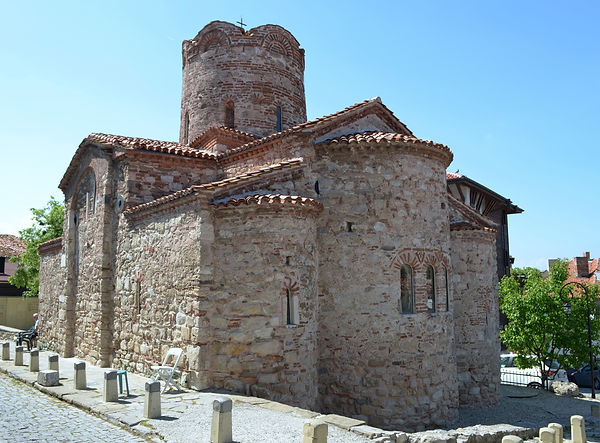
The Panagia Church in Kaynarca has been compared to the Church of St. John Prodromos in Mesembria (modern Nesebar, Bulgaria)

Plan by Mamaloukos


Reconstructed Plans by Mamaloukos


References
Soustal, P. Thrakien (Thrakē, Rodopē und Haimimontos). (Tabula Imperii Byzantini 6)
Külzer, A. Ostthrakien (Eurōpē). (Tabula Imperii Byzantini 12)
Günay, G. Life in the Rupestrian Landscapes of Byzantine Thrace: Rock Tales of the Strandzha Mountains (unpublished PhD thesis)
Mamaloukos, S. “Ο ναός της Παναγίας στη Γέννα της Ανατολικής Θράκης” (Περί Θράκης 4)
Papachristodoulou, P. “Ο Ναός της Γέννας Ανατολικής Θράκης” (Αρχείον 22)
Ousterhout, R. “The Byzantine Architecture of Thrace: The View from Constantinople” in Bakirtzis, C., Zekos, N. & Moniaros, X. Byzantine Thrace: Evidence and Remains
Resources
Genna/Kaynarca Album (Byzantine Legacy Flickr)
Byzantine Thrace Album (Byzantine Legacy Flickr)
Kaynarca Kaya Kilisesi (Kırklareli Kültür Varlıkları Envanteri)
Kaynarca Kilise Kalıntısı (Kırklareli Kültür Varlıkları Envanteri)

