Maiden’s Tower
Kız Kulesi

Kız Kulesi (“Maiden’s Tower”) is an Ottoman tower on an island near the Asian shore of the Bosphorus. In the mid-twelfth century, Manuel I Komnenos built a tower on the island, which was known as Arkla. This tower, which survived into the Ottoman era, was later restored and reconstructed. It is now one of the major landmarks of modern Istanbul.

The so-called “Maiden’s Tower” (Turkish Kız Kulesi) is an Ottoman tower on an island off the Asian shore of the Bosphorus at Salacak/Üsküdar. The current Ottoman tower, including its six floors and flagpole, has a height of over 25 m. It has a ground plan of 18 x 21 m and the tower measures 7.20 m².
Its name comes from an Ottoman legend about a sultan imprisoning his daughter in the tower to protect her. A fortune teller had told the sultan that his daughter would be killed by a snake, so he sent her to this tower, but one day she was killed by a snake hidden in a basket of grapes that was brought to her. Evliya Çelebi associated this tower with Battal Gazi.
By the seventeenth century, European travelers mistakenly called it the “Tower of Leander”, after the mythic figure who tried to swim across the straits to reach Hero. In fact, this legend was linked to the Dardanelles Straits, rather than the Bosphorus.
It is possible that a tower was first built on the island in antiquity. During the Peloponnesian War, Alcibiades built a custom house at Chrysopolis in 410 BC. This custom house, which could have been built on the island where the Maiden’s Tower is now located, collected a 10% tax on all traffic through the Bosphorus.
Manuel I Komnenos (1143-1180) constructed a tower on the island near Damalis. It is reported that he constructed the tower so that a chain could be stretched across the Bosphorus to block any potential enemy ships attacking, though no source mentions the use of such a chain. The name Arkla first appears in Late Byzantine sources, which presumably derives from the Latin arcula (“small castle”). During the Ottoman siege of 1453, Gabriele Trevisano, the captain of the Venetian triremes, defended the tower with 50 soldiers. While there was a daily exchange of artillery, no major action took place here.
The tower was rebuilt on a larger scale by Mehmet II after his conquest of Constantinople in 1453. Reportedly, the island was connected to the shore by a jetty, which formed a small harbor. The island was also supposedly supplied water by an underwater channel. It was then equipped with cannons to control traffic and prevent enemy ships from entering the Bosphorus. The tower was repaired after being severely damaged by the earthquake of 1509.
At some point, it seems that it mainly functioned as a lighthouse, though it was destroyed by a fire in 1721. The tower was subsequently rebuilt in stone by the Ottoman grand vizier Damad Ibrahim Pasha in 1725. During the Ottoman era, cannons were often fired from the island during ceremonies, such as the accession of new sultans. Hekimoğlu Ali Pasha was briefly imprisoned in the tower in 1755.
It briefly functioned as a quarantine station during a cholera epidemic in the early 1830s. Restoration work was carried out in 1832 by order of Sultan Mahmud II. This work included the addition of a segmented Baroque dome with a flagpole, giving its present form. Concrete was used when it was restored by the port authority in 1945. In 1959, it was transferred to the Turkish navy, which used it as a radar station. Its cistern was filled with concrete at this time. In 1983, it was returned the port authority. During this time, cyanide was briefly stored in the tower. The tower was restored again in 1999 and more recently in 2023. It was transferred to the Ministry of Culture and Tourism in 2020.


Aerial photo by Kadir Kır


Damalis
Damalis (Δάμαλις) was a name of the promontory at the southern end of the Asian shore of the Bosporus directly opposite the small island of Maiden’s Tower (historic Arkla) around modern Salacak/Üsküdar. This promontory was also considered the starting point for crossing the Bosphorus, particularly in the Komnenian era.
It was usually called Bous in antiquity. Its name Bous (Βοῦς “Cow”) was associated with the myth of Io, who was turned into a cow by Zeus. The transformed Io was said to have crossed the Bosphorus (“Cow Passage”), landing at the site of Bous.
Several sources mention a monument dedicated to Boiidion, the wife or mistress of Athenian general Chares, who died here around 340 BC. Chares was the commander of an Athenian grain fleet captured by Philip during his siege of Byzantion. The monument, which was a column or funerary stele, was crowned with a heifer (damalis), giving the site its name for centuries to come. The monument, which seems to have survived until the Middle Byzantine era, had an inscription referenced in several Byzantine sources.
Damalis is frequently mentioned in Middle Byzantine sources, particularly during the reign of the Komnenian dynasty. While Chalcedon was the most important ferry harbor in the Early and Middle Byzantine eras, Chrysopolis (Damalis) replaced Chalcedon as the main ferry harbor during the Komnenian era. Byzantine sources sometimes describe Damalis as located in Chrysopolis or as identical to Chrysopolis. Damala is also the Arabic name used on the twelfth-century map made by geographer al-Idrisi. Eventually, the name Chrysopolis disappeared, being replaced first by Damalis and later by Skoutari (Üsküdar).
During the siege of 626, the Persian forces were camped from Damalis to Chalcedon. The failed revolt of Constantine Doukas in 913 resulted in many of his supporters being impaled from Damalis to the east. Nikephoros Melissenos, who rebelled against Nikephoros III Botaneiates in 1080, advanced with his troops as far as Damalis.
At the beginning of the reign of Emperor Alexios I (1081-1118), Turks under Sulayman ibn Qutlumush (Solymas/Süleyman) conducted raids in Bithynia as far as Damalis. Alexios first responded by sending small detachments by boat to attack raiders near the shores at night. This in turn allowed for more effective attacks against invaders, expelling the Turks from Nicomedia and other regions of Bithynia, and leading to a peace treaty formally recognizing the Drakon River as the border. After the death of Sulayman in 1086, Turkish raids once again reached Damalis. In 1097, Bohemond and other leaders of the First Crusade sailed across the Bosphorus at Damalis.
Alexios I sailed across the Bosporus to Damalis, thus starting his campaigns against the Turks in 1113. The German king Conrad III, leader of the German army of the Second Crusade, crossed the Bosphorus at Damalis in 1147. Sicilian Norman ships attacked Damalis in 1149, but were repulsed with losses. The Palace of Skoutarion, the important suburban imperial residence, was built during the Komnenian era (probably by John II or Manuel I) at Chrysopolis (Damalis). Its name Skoutarion (Scutari), which eventually replaced the names Chrysopolis and Damalis, is also the source of the Turkish name Üsküdar.
In 1169, Manuel I Komnenos had the Stone of the Unction brought from Ephesus to Damalis, where it was ceremonially transferred to Constantinople. In 1175, Emperor Manuel I Komnenos crossed the Bosphorus at Damalis on his way to Dorylaion. Andronikos I Komnenos stayed at Damalis for a period of time before heading to Constantinople in 1182. Turkish forces reached Damalis during an invasion of Bithynia in 1192.

Damala
Damala [Damalis] (دمالة) in BNF MS Ar 2221
Late 13th-early 14th century copy of map by Muhammad al-Idrisi

Copy of Buondelmonti (1422)
From The Annals of Niketas on the tower constructed by Manuel Komnenos
A work of this emperor was the tower standing not far from the sea whose waves washed the dry land called Damalis; another tower was built on the opposite side of the straits right next to the Monastery of Mangana. The emperor constructed these towers in order to block the occasional attacks by barbarian ships by stretching an iron chain from one shore to the other, thus rendering impenetrable both the regions in the vicinity of the City's acropolis and the channel whose waters coursed all the way to the palace complex in Blachernai.
From The Chronicle of George Sphrantzes
In the defense of our harbor, Gabriele Trevisano, the captain of the Venetian triremes, with fifty soldiers, watched and guarded the tower in the middle of the channel, which protected the entrance to the harbor as far as the Imperial Gate, he performed his duty more like a shepherd than a mercenary Antonio Diedo, the captain of the merchantmen, retained the command of his own vessels and of those positioned behind the boom, as previously described. These ships were well equipped and arranged in battle order; consequently, their crewmen daily challenged the Turkish fleet with trumpets, drums, and countless calls; there was exchange of artillery daily, but no major action.
From The Seyahatname by Evliya Çelebi on Kız Kulesi
Located a bowshot's distance from the land in the sea, it is a tall, ornate, square tower. Its height is exactly 800 cubits, and its width is 200 paces. It has an iron gate facing one side. Inside, there are seven levels of rooms. It has fresh water in a cistern collected from rainwater. Its commander, Çelebi Güce, has 100 soldiers, and 40 cannons lined up on the shore, and an excellent arsenal.

Arcla in copy of Buondelmonti (1422)

Arcla in copy of Buondelmonti (1422)
From The Annals of Niketas Choniates
Expatiating on the former tome, he resorted to discrepant elaboration and rhetorical embellishments which he then epitomized, and thus once again making the doctrine enticing, he publicly posted a second tome. since he happened to be residing then in Damalis at the palace complex called Skoutarion to benefit from its mild climate and gain relief from the crowds of people while receiving thorough medical care, by imperial command the assembly of bishops and all those who were honored because of their learning sailed thither.
Once the affairs of the palace were being managed by Andronikos's sons and supporters according to his will and pleasure, he finally departed from Damalis [April 1182]. As he was crossing over the straits, he cheerfully recited under his breath the verse from David, “Return to thy rest, O my soul; for the Lord has dealt bountifully with thee. For he has delivered my soul from death, mine eyes from tears, and my feet from falling.”
From The Alexiad by Anna Komnene: on the rebellion of Nikephoros Melissenos in 1080
While these events occurred, a rumour spread that Melissenos was near Damalis with a strong force, already proclaimed emperor and clothed in the purple. At the time the Komnenoi were not inclined to believe it, but Melissenos who had heard of their activities quickly sent ambassadors to them with letters. The envoys arrived and handed them over. They read something like this: “God has brought me safe and unharmed with my army as far as Damalis…”
Botaneiates realized that the rebel army of the Komnenoi was very numerous, extremely diverse, and was already closing in on the gates of the city; he was also aware that Nikephoros Melissenos was near Damalis with an army no less powerful and with equal pretensions to the throne. His position was desperate. It was impossible to resist on two fronts. Botaneiates’ spirit had been chilled by old age; however brave he had been in his youth, he only breathed freely now as long as the walls protected him, and he was becoming more and more frightened, thinking seriously about abdicating. This terrified all his supporters and threw them into a state of confusion. Everything pointed to a total collapse.
On the raids of the forces of Solymas [Sulayman ibn Qutlumush]
As my account has already explained, the godless Turks were in sight, living in the Propontis area, and Solymas, who commanded all the east, was actually encamped in the vicinity of Nicaea. (His sultanate was located there, though we would call it his palace.) The whole countryside of Bithynia and Thynia was unceasingly exposed to Solymas’ foragers; marauding parties on horseback and on foot were raiding as far as the town now called Damalis on the Bosphorus itself; they carried off much booty and all but tried to leap over the very sea. The Byzantines saw them living absolutely unafraid and unmolested in the little villages on the coast and in sacred buildings. The sight filled them with horror. They had no idea what to do.
The emperor, aware of this, found it hard to decide what plan to adopt. However, after considering many schemes, with frequent changes and experiments, he chose the best and as far as he could, put it into practice. He appointed commanders of units of ten men from the men who had been hurriedly conscripted – Romans and some recruits who came originally from Khoma – and made them embark on small ships, the lightly armed holding bows and shields only, the others who were able-bodied equipped with helmets, shields and spears. They were ordered to make their way secretly at night round the headlands offshore and then, if they were sure the enemy did not greatly outnumber them, to leap from their ships and raid the Turks; they were then to re-embark and return to base at once. These men, he knew, were absolutely ignorant of warfare, so he warned them to instruct their rowers to make no noise with their oars; they were told, too, to beware of barbarians lurking in rocky inlets.
…By various means he had driven the Turks from Damalis and the coastal districts near it; at the same time he had won their friendship with gifts; he had forced them to accept a treaty of peace. He set the frontier with them at the River Drakon, and made them promise never to cross over it and to stop with immediate effect any incursion into Bithynia.
From The History of John Kinnamos
When Conrad heard this and learned simultaneously what late misfortune had befallen the Germans, he boarded a wretched skiff which was pulled up someplace on the seashore there, crossed the strait of Damalis, and quickly reached the opposite shore, because a certain barbaric heedlessness drove the man. For in prosperity the barbarian is likely to be exalted and boast beyond measure, but in disaster he is downcast more than is suitable and is immoderately humbled. As the emperor was minded to humiliate him still further, he acted as follows. Sending some Romans to the rear of the Germans’ army, he corrupted with money some, reputed innumerable, to withhold their allegiance to Conrad.
So matters went there. When the Sicilian fleet came grips with Chouroup, most of it was overcome, but forty of their ships avoided peril and reached Byzantion. After they had come to land there, they achieved nothing worthy of account. When they had striven to set fire to the wharves around the region of Damalis across [from Constantinople], they shamefully departed, having lost many of their own men. Nor did those who fled danger entirely escape. For encountering the ships which convoyed the public revenue from Crete, many of them became the spoil of battle.

Matrakçı Nasuh (1533)
From the Letters of Manuel II Palaiologos
There is one remedy which Lesbos does have for this affliction, just as Egypt has the Nile, that is, the northerly winds of summer, although lately they have not been blowing here as they usually do. And I am afraid someone in a vision might realize that the climate in your city would be healthier if it alone were to enjoy all these winds, and some contraption might be built for this purpose around the Mangana and the Arkla; thus even in the matter of the winds you will be better off than we are.

From map by Piri Reis (16th century)

Detail from map in the Hünername (c. 1584)

Detail from Giovanni Andreas Vavassore (c. 1535)
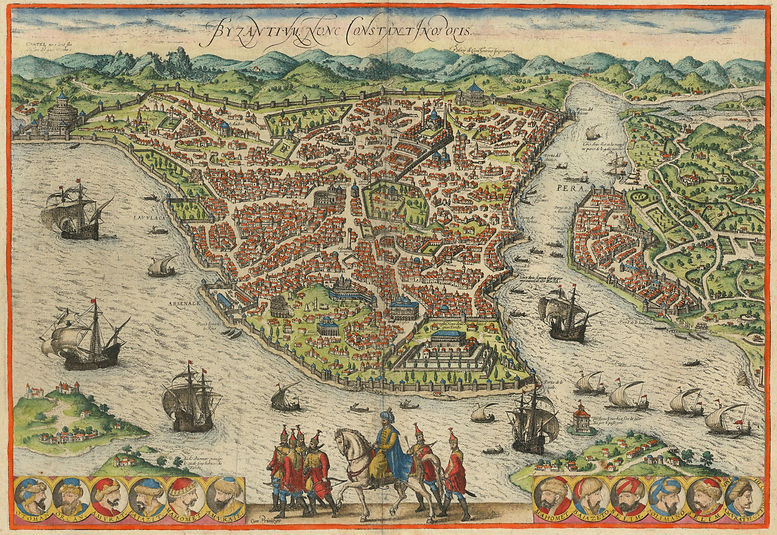
Braun & Hogenberg (1572)
.jpg)
Jérome Maurand (1544)

Guillaume-Joseph Grelot (1680)

Guillaume-Joseph Grelot (1680)
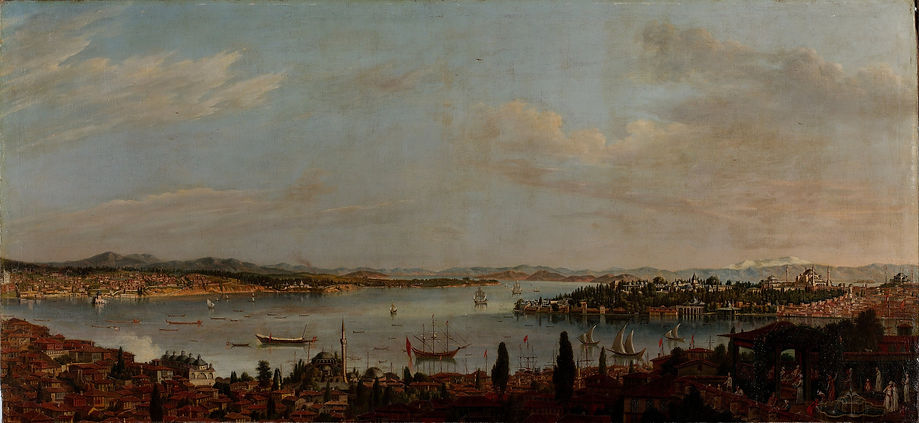
Antoine de Favray (late 18th century)
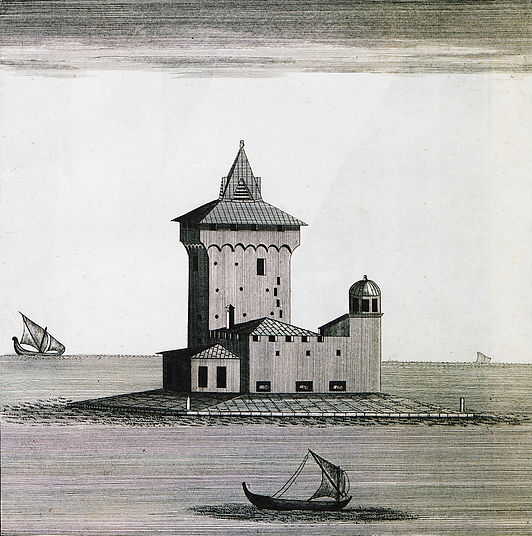
Cosimo Comidas (1794)

Antoine-Laurent Castellan (1811)

Henry Aston Barker (1813)
From Dionysius of Byzantium: On Bous, located between Chrysopolis and Chalcedon
Next a headland protrudes, exposed to the pounding of the sea. For much current is driven against it, toward the so-called Bous [“Cow”]. This is a sort of launch point for crossing to Europe, with a white marble column on which is a cow, which Chares the Athenian general made after the funeral of his concubine Boidion [“Calf”], who expired here. The inscription shows the truth of this account. Meanwhile, those who make their historical inquiry casually and without taking any trouble assume the image is of the ancient end and are led far astray.
From The Histories of Polybius: On the current of the Black Sea
From there it executes an about-turn, so to speak, and reverts once more towards the European coastline, which it strikes at the headland known as the Hearths, and then it flows back again and reaches the Asiatic coastline at a place called Bous, which is where in legend Io first set foot in Asia after crossing from Europe. Finally, however, the current flows from Bous straight towards Byzantium, but it divides near the city. A lesser branch forms the inlet called the Horn, while the main current rebounds again. But it no longer has sufficient strength to reach the opposite coastline, where Chalcedon is located, because it has already rebounded several times and the strait is wider by then…This is proved by the fact that in order to sail from Chalcedon to Byzantium one cannot simply head in a straight line across the intervening current; one has to take a roundabout route via Bous and Chrysopolis, and then let the boat be carried by the current, which will take it towards Byzantium anyway.
From The Hellenica of Xenophon: On a customs house at Chrysopolis
Next day they sailed out against Cyzicus. The town had been evacuated by the Peloponnesians and Pharnabazus, and the townspeople received the Athenians inside the walls. Alcibiades stayed there for twenty days and raised large sums of money from the citizens. Then, without doing any other harm to the place, he sailed back to Proconnesus and went on from there to Perinthus and Selymbria. The people of Perinthus allowed his forces inside their walls, and the people of Selymbria, while not letting them inside, contributed money. Next they went on to Chrysopolis, in Calchedonia, and built fortifications there. They established a customs house in the city and began to levy a ten-per-cent tax on all cargoes sailing out through the Bosporus. They left behind there as a garrison thirty ships with two of the generals, Theramenes and Eumachus. Their duties were to look after the fort, to levy the tax on outgoing ships and to do any other harm they could to the enemy. The other generals then went back to the Hellespont.

Charles Pertusier (1813)

Antoine Ignace Melling (1819)

Choiseul-Gouffier (1822)
From The Chronicle of Constantine Manasses
While Herakleios was still in Persia, and the Persian army was still laying siege to the prosperous city and gaping open to devour it, another harsh, thundering, billowing storm arose, roaring terrifyingly like a lion, threatening to flood the great ship of state. The Scythian forces and the phalanxes of the savage Avars, equal in number to grains of sand, gathered with the Persians. They surged together like deafening torrents and roared around the city like clashing rivers. The Persians had camps opposite the city, for their forces flowed from Damalis to Chalcedon with a deep rumble.
From The Patria of Constantinople by Hesychius
And when Leo too had quitted his life, Chares, the Athenian stronger, came to support the Byzantines with forty ships in the war with Philip and reached the promontory of the Propontis which lies between Chrysopolis and Chalkedon; and anchoring there he tried his hand at war. Here he lost the woman who accompanied him, when n she was struck down by an illness, and he buried her in a grave and set up an altar for her and a composite column, which shows a heifer of hewn stone. So perhaps she bore the name which has been preserved down to our day in the inscribed verses. These are the verses:
I am not the image of the cow, the daughter of Inachos,
nor is the facing Bosporian sea named after me.
In olden times the severe wrath of Hera drove her
to Pharos, but here I am, a dead descendant of Kekrops.
I was the wife of Chares and sailed when he sailed here, against Philip's ships.
Then my name was cow, now Chares wife, I am gladdened by both continents.
From On The Themes by Constantine VII Porphyrogenitus
There are two places called Bosporos: the first is the so-called Cimmerian, near to Cherson, where the kingdom of the Bosporans used to be; the other is in Byzantion, as Favorinus writes: “The harbour of Byzantion is called Bosporion.” Another witness is the epigram on the column in the opposite district of Chrysopolis, where there stands a marble heifer [damalis], saying [quotes inscription]…

Anonymous (c. 1820)

Thomas Allom (1836)

Thomas Allom (1836)

W.H. Bartlett (1838)

W.H. Bartlett (1838)

Joseph Schranz (1850)

Eugène Flandin (1856)

Eugène Flandin (1856)

Album zur Erinnerung an Constantinopel (1860?)

C. Bertrand (1864)

Ivan Aivazovsky (1848)

Alexei Petrovich Bogoliubov (1856)

Carlo Bossoli (1854)
.jpg)
Sanford Robinson Gifford (1876)

Mgrdich Givanian (1848-1906)

Carl Saltzmann (c. 1890s)

Pascal Sébah (c. 1865-1870)

Pascal Sébah (c. 1865-1870)

Pascal Sébah (c. 1865-1870)

Vassilaki Kargopoulo (c. 1865-1870)

Guillaume Berggren (c. 1880s)

Abdullah Frères (1880s-1890s)

Abdullah Frères (1880s-1890s)

Abdullah Fréres (c.1880-1893)

Gülmez Frères (c. 1890)

Sebah & Joaillier (c. 1890s)

Ali Sami

Neue Photographische Gesellschaft (1905)
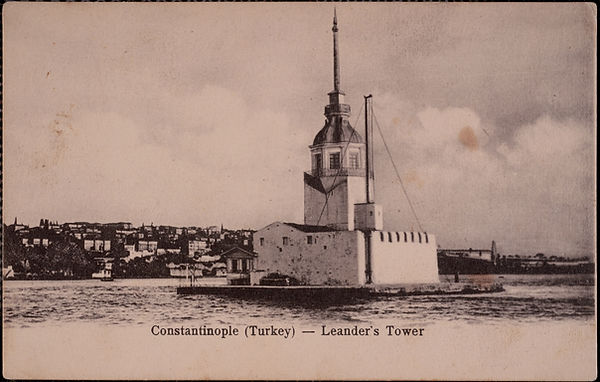
Postcard (c. 1900-1907)

From Hermann Barth (1913)

Postcard (c. 1900-1923)

Postcard (c. 1915-1930)

Detail of map by Stolpe (1882)

Plan from Dabanlı


References
Belke, Klaus. (ed). Bithynien und Hellespont (Tabula Imperii Byzantini, Vol. 13)
Janin, R. Constantinople Byzantine: développement urbain et répertoire topographique
Müller-Wiener, W. Bildlexikon zur Topographie Istanbuls: Byzantion, Konstantinupolis, Istanbul bis zum Beginn d. 17. Jh
Daim, F. & Kislinger, E. (eds) The Byzantine Harbours of Constantinople
Beihammer, A. Byzantium and the Emergence of Muslim-Turkish Anatolia, ca. 1040-1130
Gülersoy, Ç. “Kız Kulesi” (İstanbul Ansiklopedisi)
Dabanlı, Ö. “İstanbul Kız Kulesi: Taşıyıcı Sistemin Mevcut Durumu Hakkında Teknik Rapor”
Sources
Kiesling, B. (trans.) Dionysios of Byzantium: Anaplous of the Bosporos (ToposText)
Waterfield, R. (trans.) Polybius: The Histories
Warner, B. (trans.) Xenophon: A History of My Times (Hellenica)
Yuretich, L. (trans.) The Chronicle of Constantine Manasses
Berger, A. (trans.) Accounts of Medieval Constantinople: The Patria
Sewter, E. (trans.) Anna Komnene: The Alexiad
Haldon, J. (trans.) De Thematibus ('on the themes') of Constantine VII PorphyrogenitusBrand, C. (trans.) Kinnamos: The Deeds of John and Manuel Comnenus
Magoulias, H. (trans.) O City of Byzantium: Annals of Niketas Choniatēs
George T. Dennis, G. (trans.) The Letters of Manuel II Palaeologus
Philippides, M. (trans.) The Fall of the Byzantine Empire: A Chronicle by George Sphrantzes, 1401-1477
Kahraman, S. and Dağlı, Y. (ed) Günümüz Türkçesiyle Evliyâ Çelebi Seyahatnâmesi 1.2, İstanbul
Petrus Gyllius. De Bosphoro Thracio libri III
Resources
Maiden’s Tower Album (Byzantine Legacy Flickr)

