Astrabeke
Seyrek/Kocaeli
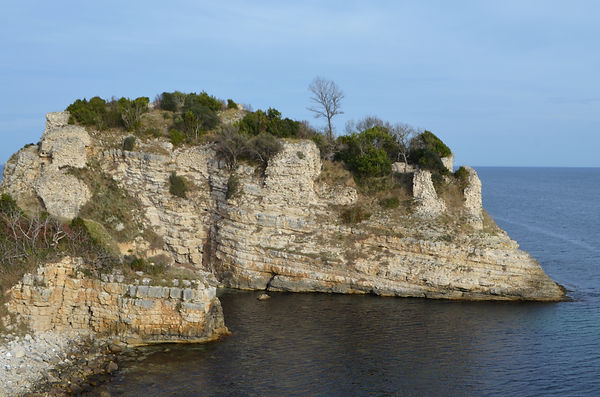
Astrabeke (Ἀστραβήκη, modern Seyrek) was a Late Byzantine town with a natural harbor on the Black Sea coast of Bithynia, now in the district of Kandıra in Kocaeli. It was around 40 km east of Chele (modern Şile) and 8 km west of Karpe (modern Kerpe), two key local Byzantine settlements in the Late Byzantine era.
Astrabeke first appears in the sources when mentioned together with Chele in the 14th century by historian George Pachymeres and the Russian traveler Ignatius of Smolensk. The castle of Astrabeke (Seyrek Kalesi) that protected its harbor dates to the Late Byzantine era. It was part of a series of fortifications that protected the coast and provided shelter from Ottoman raids in the 14th century. Astrabeke was attacked by the Ottomans in 1304 and was under Ottoman control by 1389. Records mention a Greek vineyard shortly after it was conquered. The settlement continued to be included church lists in later centuries.
The ruins of Seyrek Castle are located on a rocky promontory on the western side of the harbor. This promontory is only connected to the mainland by a relatively narrow strip of land, which made it easy to defend from a landward siege. The remains of the walls run along the edge of the cliff, with at least two square towers facing the mainland and a round tower and two square towers facing the harbor. It shares architectural features with fortresses along the Sangarius (Sakarya) River built by Michael VIII Palaiologos (1261-1282). It can also be compared with the fortresses at Chele, Hieron (Yoros Kalesi), and even Niketiation, which protected Western Bithynia in the Late Byzantine era.

From the History of George Pachymeres
The enemies not only attacked Chele and Astrabete, but even the fortress of Hieron, and they carried out the most terrifying of deeds, as if the Emperor were slumbering or no longer living. Nicomedia was weakened by famine and, due to lack of water, found itself in the greatest of troubles. The famous Nicaea was closed and, cut off from surrounding amenities, and it too was hampered by shortages.

Astrabeke (Seyrek) Harbor
From Ignatius of Smolensk
Opposite the city of Amastris we began the fast for St. Peter's Day. On Tuesday we passed Pontic Heraclea, but on Wednesday a contrary wind arose and we returned to Pontic Heraclea where we remained for nine days. The Church of St. Theodore Tyro is there. His tomb is inside [the church], since this is the place of his martyrdom. We left there for Constantinople in caiques on the Nativity of St. John the Baptist on Friday morning we passed the city of Diospolis, and on Saturday we lunched at the mouth of the river Sangarius. On Sunday we passed the city of Daphnousias, Karphia, and arrived at the city of Astrabike where the metropolitan stopped to get news of Murad, since Murad had attacked the Serbian Prince Lazar. There was news too: both Murad and Lazar had been killed in the encounter. Fearing a disturbance, since we were in the Turkish state, the metropolitan dismissed the monk Michael; Bishop Michael [dismissed] me, Ignatius; and Sergius Azakov [did the same] with his monk. We left Astrabike [Astravija] on the Sunday before St. Peter's Day; the next morning we left Chile, passed Rheba, and arrived at the mouth [of the Bosporus]. We passed the lighthouse, and with a very good wind, to our unspeakable joy we reached Constantinople.


References
Sağlam, H. Sercan, “Şile and Its Castle: Historical Topography and Medieval Architectural History”
Belke, Klaus. Bithynien und Hellespont (Tabula Imperii Byzantini 13)
Primary Sources
Cassidy, N. (trans) A Translation and Historical Commentary of Book One and Book Two of the Historia of Georgios Pachymerēs (MA thesis)
Majeska, G. (trans) Russian Travelers to Constantinople in the Fourteenth and Fifteenth Centuries
Resources

